By BOBOS · 13 November 2026 · 2 min read
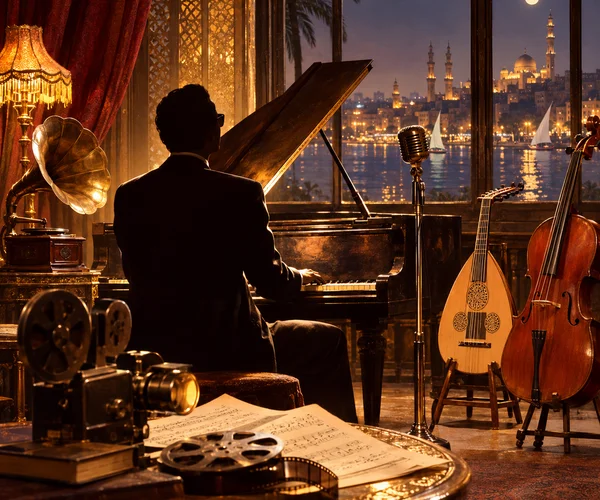
His title, "Musician of Generations", is no exaggeration. Mohamed Abdel Wahab lived for about ninety years and composed for one generation after another, from Umm Kulthum to Abdel Halim, Nagat and Fayza Ahmed. Even today, when a big event like the Cairo International Film Festival wants an opening worthy of it, it turns to his music.
From Bab El-Shaariya to the palaces
Abdel Wahab was born in Cairo's Bab El-Shaariya district; his birth date is disputed, but the best-known year is 1902. He loved singing from childhood and would slip away from home to hear singers at religious festivals and to sing with small troupes. The turning point came when the "Prince of Poets", Ahmed Shawki, heard him and took him under his wing, opening the doors of culture, travel and high society, and Abdel Wahab sang many of his poems.
The first star of the musical film
Abdel Wahab was among the first to bring song into Egyptian cinema. The film "The White Rose" in 1933 was a major step, followed by other films that carried the song into every home through the screen. He did not just compose; he changed how people listened to songs.
Piano, cello and guitar at the heart of the Eastern song
His most important contribution was his courage to experiment. He brought Western instruments such as the cello, piano, guitar and accordion into the Arabic song, and borrowed rhythms from the tango, waltz and rumba, yet his melodies remained deeply Egyptian and Eastern. It caused real controversy at the time, but it opened the way for everyone who came after him.
"The meeting of the clouds"
For years, people waited for Abdel Wahab to compose for Umm Kulthum, the two biggest names in Arabic music. It finally happened in 1964 with "Enta Omri", a collaboration nicknamed "the meeting of the clouds". He went on to compose more songs for her, including "Amal Hayati" and "Fakarouni".
A whole school
Abdel Wahab composed "Ahwak" for Abdel Halim Hafez, "Ayazunnu" for Nagat El-Saghira and "Set El-Habayeb" for Fayza Ahmed, still sung every Mother's Day. He died on 4 May 1991, leaving hundreds of melodies and instrumental pieces such as "Anshoudet El Fan", played this year at the opening of the Cairo Film Festival.
Why does Abdel Wahab matter to us today?
Abdel Wahab taught me that renewal does not mean forgetting your roots. He brought in foreign instruments and rhythms from everywhere, yet anyone listening knows from the first note that this is Egyptian. That is what I try to do: use today's tools and stay Egyptian. If you want to hear music without words, listen to Music radio on BOBOS FM.

More articles
- Want to be a singer? The complete step-by-step guide to learning to sing and vocal exercises
- Ammar El-Sherei: the "Diver in the Sea of Melody" who composed the music of "Raafat El-Haggan"
- Sayed Mekkawy: the sheikh who saw music with his heart and composed "El-Leila El-Kebira" and "Ya Mesaharni"
- All articles