By BOBOS · 9 November 2026 · 2 min read
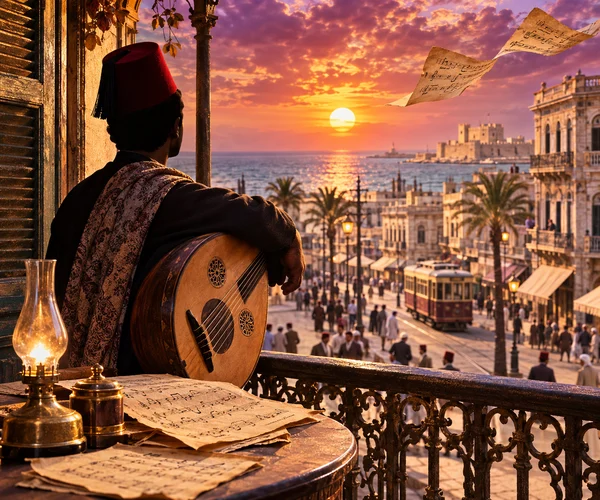
He never turned 32, and yet his melodies are still sung today in schools, stadiums, protests and weddings. Sayed Darwish is not just an old composer: he is the man who moved the Egyptian song from the pashas' palaces into the people's streets.
A son of Kom El-Dikka
Sayed Darwish was born on 17 March 1892 in Kom El-Dikka, a working-class district of Alexandria. He studied at a traditional Quran school, and his beautiful voice had him singing at religious festivals and family occasions from a young age. As a young man he did many jobs to make a living, including construction work, where he sang to the workers, and people began to notice that this young man had something different.
Music that speaks the people's language
Before Sayed Darwish, singing in Egypt was mostly traditional tarab, heavily influenced by Turkish music and performed for the rich in salons. He did something simple and revolutionary at the same time: he made the song tell the story of ordinary people.
He sang for water carriers, porters, cart drivers and craftsmen, in their dialect and with their feelings. A song like "El-Helwa di" describes the early morning of a simple Egyptian woman, and "Salma ya Salama" became the song of everyone coming home from a journey. For him the melody served the words and their meaning, not just a show of vocal skill.
The voice of the 1919 revolution
When the 1919 revolution broke out, his melodies were everywhere. "Oum ya Masri" and "Aho dah elli sar" became songs of the street, sung in protests. His most famous melody of all, "Biladi Biladi", whose words were taken from a speech by the nationalist leader Mustafa Kamel, later became Egypt's national anthem in 1979 and remains so today.
Musical theatre
Sayed Darwish took Egyptian musical theatre to a new level. He composed dozens of operettas and musical plays for major troupes such as those of Naguib El-Rihani and Ali El-Kassar, most of them with the writer Badie Khairy. His operettas were not songs placed side by side: they had drama and characters, and each character had a singing style to match.
An early end and an endless influence
Sayed Darwish died on 15 September 1923, aged only 31. His artistic career lasted less than ten years, yet the melodies he left were enough to earn him the titles "the People's Artist" and "the father of the musical renaissance".
Those who came after him, from Mohamed Abdel Wahab to today's composers, all learned the most important lesson from him: real Egyptian music is the music that comes from the street and from people's lives.
Why does Sayed Darwish matter today?
As an independent artist who writes, composes and sings on my own, I see a clear example in Sayed Darwish: you don't need to imitate anyone to reach people. He took the sounds of the Egyptian street and turned them into art, which is exactly what I try to do in my songs: Egyptian dialect, real stories, people's feelings. If you want to hear Egyptian music without words, listen to the Music radio on BOBOS FM.

More articles
- Want to be a singer? The complete step-by-step guide to learning to sing and vocal exercises
- Ammar El-Sherei: the "Diver in the Sea of Melody" who composed the music of "Raafat El-Haggan"
- Sayed Mekkawy: the sheikh who saw music with his heart and composed "El-Leila El-Kebira" and "Ya Mesaharni"
- All articles