By BOBOS · 13 November 2026 · 2 min read
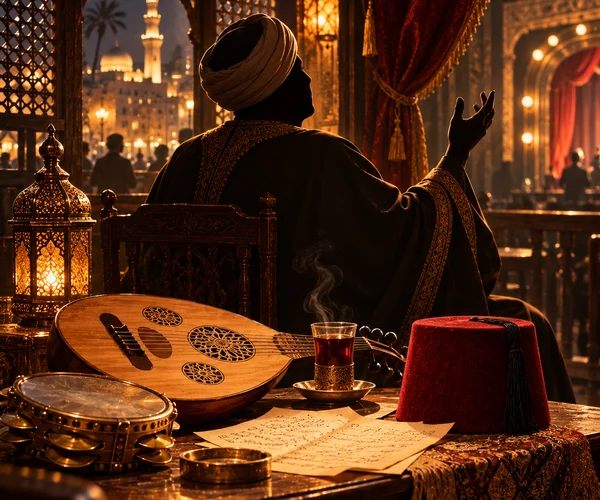
Sheikh Zakaria Ahmed wore a turban and robe and came from the Quran school and religious chanting, yet he became one of the most important composers of popular and classical Egyptian song in the twentieth century.
From Al-Azhar to the stage
Zakaria Ahmed was born in Cairo in 1896, studied at Al-Azhar and learned religious chanting from great sheikhs. As a young man he worked with chanting troupes, then entered musical theatre and composed many operettas, combining the spirit of religious chanting with the wit of Egyptian theatre.
Zakaria and Bayram El-Tunsi
One of the finest pairings in Egyptian song: lyrics by Bayram El-Tunsi and music by Zakaria Ahmed. Bayram wrote in the language of the Egyptian street, Zakaria composed with a purely Egyptian spirit, and the result was songs that still live today.
With Umm Kulthum
Zakaria Ahmed was among the first composers to shape Umm Kulthum's style in the 1930s and 1940s. He composed "El-Awwela fil Gharam", "Ana fi Entezarak", "El-Ahat" and "Ahl El-Hawa" for her, many with lyrics by Bayram El-Tunsi. His melodies were close to people and full of real tarab.
The quarrel and the reconciliation
In the 1950s a major dispute over royalties broke out between Zakaria and Umm Kulthum, reaching the courts and keeping them apart for years. But the story ended well: they reconciled, and the first melody after the reconciliation was "Howa Sahih El-Hawa Ghallab" in 1960, which became one of her most famous songs.
Farewell
Only months after the reconciliation, Sheikh Zakaria Ahmed died on 14 February 1961, leaving hundreds of melodies, as if "Howa Sahih El-Hawa Ghallab" had been his final gift.
Why does Zakaria Ahmed matter to us today?
Zakaria reminds me that true art can come from anywhere: the Quran school, the religious festival, the street. And that no quarrel is bigger than the art. If you love authentic Egyptian tarab, listen to Songs radio on BOBOS FM.

More articles
- Want to be a singer? The complete step-by-step guide to learning to sing and vocal exercises
- Ammar El-Sherei: the "Diver in the Sea of Melody" who composed the music of "Raafat El-Haggan"
- Sayed Mekkawy: the sheikh who saw music with his heart and composed "El-Leila El-Kebira" and "Ya Mesaharni"
- All articles