By BOBOS · 8 November 2026 · 7 min read
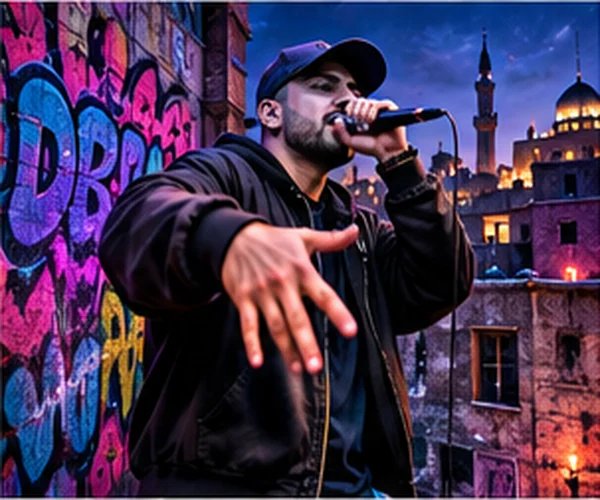
Nobody expected a style that appeared in New York neighbourhoods in the 1970s to become one of the most widespread youth music movements in the world. Rap, which began as a way to express social reality and protest against marginalisation, is today a global music industry, and when it reached the Arab world it took on a different personality in each country.
But how did rap travel to the Arab region? Who first presented it? And how did it grow from limited youth experiments into an industry with stars and millions of listeners?
The beginning: the Bronx, New York
To understand the birth of Arab rap, we first need to go back to the United States in the 1970s, specifically to the Bronx in New York City.
At that time some African American and Latino communities were suffering from poverty, marginalisation and social problems. In those conditions hip hop culture emerged, not just as a music genre but as a complete cultural movement.
The culture was tied to four main elements:
- Rap: rhythmic vocal delivery using words and rhymes.
- DJing: making beats and manipulating records.
- Breakdancing: the dance linked to hip hop culture.
- Graffiti: artistic expression through drawing and writing on walls.
Local parties were among the most important places where the culture grew: a DJ would use sections of old records to make repeating beats while the rapper delivered his words over the music.
Over time the style developed from encouraging shout-outs and rhythmic chanting into complete songs carrying stories, personal experiences and social and political messages.
In 1979 the song Rapper’s Delight by the Sugarhill Gang became a big commercial hit and helped introduce rap to a wide audience outside the United States.
How did rap reach the Arab world?
Rap did not arrive in the Arab countries in a single day, and there is no one country that can be called the only starting point.
From the late 1980s and the 1990s different experiments began to appear in more than one place, and North Africa played an early role in welcoming this style.
Arab migration to Europe, especially France, helped carry hip hop culture to the children of North African communities. Young people of Moroccan, Algerian and Tunisian origin found in rap a way to express their double identity and their experiences in European societies.
Instead of simply copying American songs, these young people began using their own languages and dialects, and rap became a way to talk about racism, identity, unemployment and cultural difference.
As the internet spread, these experiments began moving into the Arab countries themselves, and local scenes appeared in each country.
Morocco, Algeria and Tunisia: the North African beginnings
North Africa was one of the regions with early experiments in Arab rap.
In Morocco, artists and groups appeared who used Moroccan Darija to express the issues of young people, the street and daily life. Over time Moroccan rap built a wide audience, with names such as Muslim and Dizzy DROS.
Algeria had its own scene, influenced by French and American experiences but keeping clear local features in its dialect, themes and delivery.
In Tunisia, rap appeared as a space to express social and political issues, and some of its experiments dealt with unemployment, marginalisation, corruption and everyday reality.
These scenes differed in their details, but they shared one core idea: using rap to speak about society in the language the audience understands.
Palestinian rap: music as a way to express identity
Rap in Palestine took on a special character because of the political and social conditions.
One of the best-known experiences is the group DAM, founded in Lydd in 1999, which made work in Arabic, Hebrew and English.
The group’s songs were not just musical experiments; they dealt with identity, discrimination, occupation and the daily life of Palestinians.
One of their best-known works is the song “Min Irhabi?” (Who’s the Terrorist?), which drew wide attention for its political and social message.
This experience proved that Arab rap can carry local issues to a global audience without giving up its language, culture and identity.
Rap in Egypt: from the underground to stardom
Rap entered Egypt in the late 1990s, at a time when Egyptian songs relied mainly on traditional forms of shaabi, pop and tarab.
The beginnings had limited means; many young people relied on computers, simple software and whatever beats were available, trying to rap in English or Arabic.
Among the early experiences mentioned in studies of Egyptian rap is the group W Crew, followed by others who helped widen the space for this style.
At the start of the millennium the group MTM helped introduce a wider audience to forms mixing rap, pop and comedy, becoming famous with songs such as “Ommy Msafra” (My Mother Is Travelling).
But independent Egyptian rap kept developing away from commercial forms, with groups and artists searching for their own musical identity.
With the spread of the internet, forums and file-sharing sites, audiences could hear work that never made it onto radio or television.
Then platforms such as YouTube and SoundCloud changed the rules of the game: a rapper could publish his own work without waiting for approval from a big label.
Over the last decade rap has become one of the leading trends in the Egyptian music market, with names such as Wegz, Marwan Pablo, Marwan Moussa and Abyusif, and songs reaching wide audiences and entering the digital charts.
Saudi Arabia and the Gulf: a different rap identity
Arab rap was not limited to North Africa, Egypt and Palestine.
In Saudi Arabia early hip hop experiments appeared during the 1990s and early 2000s; one of the well-known names is Qusai Kheder, who helped introduce hip hop culture to a wider Arab audience.
Groups such as Klash also appeared, and artists began using local dialects and expressions linked to Gulf culture.
Later the Gulf scene developed further, and rap became part of a growing music industry, with themes and styles varying from artist to artist.
Why did Arab rap succeed?
Several reasons helped rap spread in the Arab world.
1. Relatively easy production
An artist no longer needs a huge studio or a full band to produce a song. You can build a beat, record a voice and produce a complete track with a computer and specialised software.
2. Freedom of expression
Rap gives an artist a lot of room to talk about his experiences, ideas and problems without being bound by the traditional moulds of the song.
3. Local language
Using Arabic dialects made audiences feel the song was talking about them, their lives and their society, instead of listening to a translated version of American rap.
4. The internet and social media
Digital platforms helped break down the traditional barriers between artist and audience, and a song’s spread became tied to listeners’ sharing and engagement.
5. The development of music production
New genres such as trap entered the Arab scene, and producers began mixing Western rhythms with Eastern elements, creating new musical forms.
From rap to trap: are they the same thing?
Although trap belongs to the hip hop family, it has musical features different from many traditional forms of rap.
Trap appeared in the southern United States, tied at first to street music, then developed into one of the most influential trends in world music.
It is marked by particular electronic drums, broken rhythms, deep bass and a variety of sound effects.
In the Arab world trap has become an important space for experimentation, especially for the new generation of producers and rappers.
Did Arab rap lose its identity when it went commercial?
This question sparks continuing debate among fans of the genre.
In its beginnings rap relied heavily on independent production and on expressing street issues, while some modern work has become more tied to companies, adverts and commercial concerts.
But going commercial is not necessarily the end of artistic identity. Some artists manage to make commercially successful work while keeping their style and messages, while others choose to focus on musical experimentation or personal themes.
Most importantly, rap today is a wide world with different schools and directions, not one mould everyone must follow.
The future of Arab rap
Clearly Arab rap is no longer a passing phenomenon or a mere imitation of the West. It has a history spanning decades, local scenes in different Arab countries, and artists who have built big audiences inside and outside the region.
Developments in production and digital distribution also open the way for new voices from cities and countries that had few opportunities in the past.
Perhaps the future of this style depends on its ability to develop its own identity, drawing on local heritage without losing its modern nature.
Rap that began on the streets of New York now speaks in Egyptian, Moroccan, Gulf, Palestinian and Tunisian dialects, telling different stories about different societies.
And that is the strength of Arab rap: music that is global in its tools but has become local in its language, its stories and its soul.
Read and listen next

More articles
- Want to be a singer? The complete step-by-step guide to learning to sing and vocal exercises
- Ammar El-Sherei: the "Diver in the Sea of Melody" who composed the music of "Raafat El-Haggan"
- Sayed Mekkawy: the sheikh who saw music with his heart and composed "El-Leila El-Kebira" and "Ya Mesaharni"
- All articles