By BOBOS · 8 November 2026 · 2 min read
Egyptian music has a personality that is hard to confuse with any other style. There are rhythms a listener recognises from the very first moment, instruments with a clearly Eastern character, and a unique ability to turn a simple situation or a short phrase into a melody that stays in the memory for years.
But the question worth thinking about is: can Egyptian music evolve without losing its identity?
That question is very present in BOBOS’s musical experience. His interest does not stop at re-presenting old sounds, nor is it limited to copying popular Western trends. The core idea is to look for a space that brings the two together, so that the Egyptian spirit stays clear while the production tools become more modern.
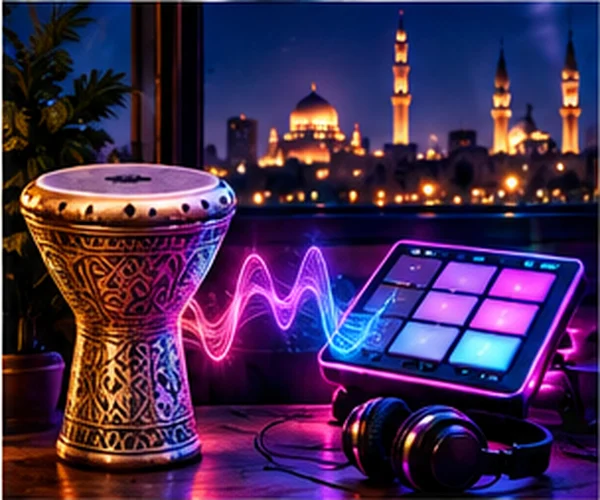
Modern electronic music offers enormous possibilities for controlling rhythm, sound and musical space. You can use deep electronic instruments, add cinematic sound layers and build a dance rhythm that suits modern sound systems. At the same time you can keep the darbuka, the tabla, the daf and Eastern instruments, and place them in a different musical context.
This blend does not mean adding an Eastern instrument to a Western song and calling the result modern Egyptian music. It goes deeper than that. The Egyptian identity has to be part of the work’s very structure: in the rhythm, the way of performing, the expression and the melody.
It is also important to understand that the audience is not one block. There are listeners who love calm music, others who prefer dance songs, and others who want the powerful beats they hear in the car or through big sound systems. So variety in musical colours is not a weakness; it is a chance to reach different audiences.
Among the experiments that could offer a new shape for Egyptian music is combining trap, electronic music, house and orchestral elements with Eastern rhythms. These combinations give a producer a wide space to experiment, as long as the work does not turn into a pile of clashing sounds.
The human voice remains essential too. Modern technology can process a voice and change some of its qualities, but a singer’s real personality does not come from effects alone. Pronunciation, feeling, timing and expression all create a vocal identity that cannot be reduced to a piece of production software.
For BOBOS, this space is the meeting point between the music he grew up listening to and the production he wants to offer. It is a direction that allows Egyptian work with a contemporary spirit, without turning into copies of foreign music.
Egyptian music does not need to give itself up in order to be modern. It only needs artists and producers with the courage to try new ways of expressing it.
The future does not necessarily belong to the loudest or the most widespread music, but to work that can combine authenticity and innovation, giving listeners an experience in which they recognise their roots while discovering something they have never heard before.
Read and listen next
More articles
- Want to be a singer? The complete step-by-step guide to learning to sing and vocal exercises
- Ammar El-Sherei: the "Diver in the Sea of Melody" who composed the music of "Raafat El-Haggan"
- Sayed Mekkawy: the sheikh who saw music with his heart and composed "El-Leila El-Kebira" and "Ya Mesaharni"
- All articles