By BOBOS · 8 November 2026 · 7 min read
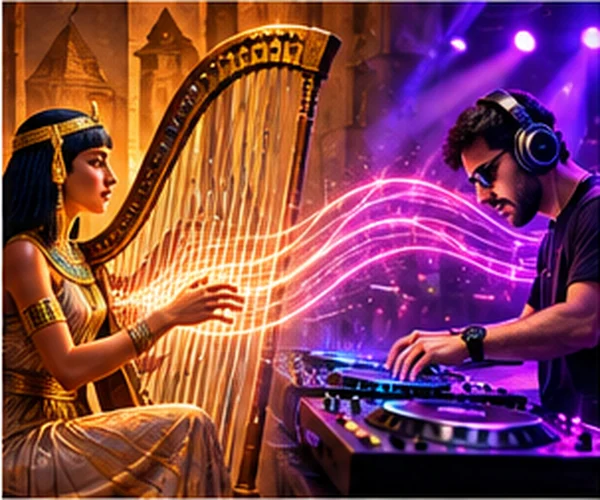
How did the ancient Egyptian listen to music? Did he feel rhythm the way we feel it today? And is there anything in common between a harpist who lived thousands of years ago and a producer working today in an electronic studio?
Comparing pharaonic music with modern music may look like comparing two unrelated worlds, but in fact there are interesting points of similarity. Instruments, techniques and ways of recording and distributing have changed, but people have kept turning to music to express their feelings, celebrate their occasions and share their ideas.
Music was part of ancient Egyptian civilisation, present in temples, palaces, celebrations and funerary occasions. Today it has become a huge global industry built on digital studios, online platforms and genres that cross geographical borders.
So how has Egyptian music changed over thousands of years?
First: instruments, from wood and skin to digital technology
The ancient Egyptians relied on a variety of instruments that can be divided into four main groups: string instruments, wind instruments, percussion, and instruments that sound through the vibration of their own parts.
Among the best-known string instruments were the harp, the lyre and the early lute, made with wood and strings. Wind instruments included the ney and double pipes, while drums, frame drums and sistrums produced the rhythms.
Modern music, by contrast, relies on an enormous range of traditional and electronic instruments. The harp, the oud, the ney and the tabla are still here, but they now work alongside the piano, the electric guitar, the synthesiser and electronic drum machines.
The big difference is that a modern producer can record one instrument, then edit it, add effects and blend it with dozens of other sound layers.
There are also virtual instruments that imitate real ones, giving music makers wide possibilities in production and arrangement.
Even so, the old instruments have not lost their value: some contemporary musicians still use traditional Eastern instruments as a core part of their musical identity.
Second: rhythm, the element that links past and present
Rhythm is one of the elements most worth comparing.
In ancient Egypt, drums, frame drums, clapping and sistrums were used at occasions and celebrations, for dancing and in religious rituals.
Modern music has developed the world of rhythm enormously, especially with drum machines and software that allow precise control of speed and timing.
Today a producer can set a track’s tempo in BPM, add repeating hits and build complex rhythms from many different sounds.
But using a rhythmic pulse to move the body and organise dance is nothing new. People have used rhythm since ancient times, and the idea is still alive in shaabi music, electronic music, hip hop and trap.
Strikingly, the tabla and the daf are still present in modern Egyptian music, despite the huge development in production tools.
Third: singing, the human being was always the most important instrument
The human voice is one of the oldest elements of music, and singing probably existed before many of the instruments we know.
Egyptian monuments point to singers, chanters and professional musicians, and some scenes show ensembles combining players, female singers and dancers.
In modern music, recording and vocal techniques have developed hugely. You can record in a studio, re-record certain parts, set levels, add effects and spread voices across separate tracks.
Many singing styles have also appeared, from tarab and shaabi songs to rap, trap, pop and electronic music.
But whatever the style, the human voice remains a way to express feelings and ideas, a role that has gone with music since the most ancient times.
Fourth: what was music used for in the past, and what does it do today?
In ancient Egypt music served many purposes.
It was used in religious rituals, palace celebrations and social occasions, in some official and military processions, and it appeared in funerary contexts tied to beliefs about the afterlife.
In modern times, the uses of music have widened to many fields.
We listen for entertainment, relaxation and dancing, we use it in cinema, adverts and video games, and it has become part of sporting events, concerts and festivals.
Music has also become a complete economic industry covering composition, recording, production, distribution, marketing and intellectual property rights.
Here lies a basic difference: ancient music was tied largely to occasions and live performance, while modern music can reach millions of listeners at the same moment through the internet.
Fifth: from the musician in the temple to the producer in the studio
In the past, presenting music depended on players and singers being in the same place, and archaeological paintings show groups of musicians performing for an audience or during rituals.
Today the way a musical work is made has changed completely.
One person can compose the melody, record the instruments, build the beat, add effects and produce a complete song with a computer and specialised software.
A producer can also send the work to digital distributors so it reaches the world’s listening services.
That means the distance between idea and final result has become much shorter, and making music is no longer limited to big institutions.
But this development does not cancel the importance of musicians and players: human skill, artistic experience and creative choices remain essential to making distinctive work.
Sixth: did pharaonic music sound like today’s Eastern music?
This is an exciting question, but the answer needs caution.
We know that the ancient Egyptians used string, wind and percussion instruments, and that music was part of their social and religious life. But we have no reliable musical notation from the pharaonic era that would tell us the melodies, modes and rhythms exactly.
So we cannot say that pharaonic music resembled today’s Egyptian music, or that its modes were the same maqams used now.
There may be similarities in some instruments or in ways of making rhythm, but similarity does not prove a direct continuity of melodies or styles.
It is also important to know that Egyptian music did not develop in one straight line: across the ages it passed through different cultural influences, from the Greek and Roman periods to the Coptic and Islamic eras and modern times.
Each stage added new elements to the musical scene.
Seventh: modern Egyptian music, how did authenticity meet modernity?
During the nineteenth and twentieth centuries Egyptian music went through major changes. New forms of composition, singing and arrangement appeared, and the record industry, radio and cinema developed.
Egyptian music gained a wide presence across the Arab world through towering names such as Umm Kulthum, Abdel Halim Hafez, Mohamed Abdel Wahab and Sayed Darwish.
Over time new instruments entered the arrangements, and songs began to benefit from multitrack recording and modern Western instruments while keeping clear Eastern elements.
In recent decades new styles have appeared, such as hip hop, trap and electronic music, alongside the evolution of shaabi songs and mahraganat.
This variety shows that Egyptian music is not a single mould but a changing artistic culture able to absorb new influences and present them again in a local style.
A quick comparison of pharaonic and modern music
| Element | Pharaonic music | Modern music |
|---|---|---|
| Instruments | Harps, neys, drums and sistrums | Traditional and electronic instruments |
| Rhythm | Drums, frame drums and clapping | Live and digital rhythms |
| Recording | Live performance, no sound recording | Studios and digital recording |
| Singing | Chanters and singers | Many singing styles |
| Reach | Performance in society, temples and palaces | Radio, the internet and global platforms |
| Purpose | Religious, social and festive | Artistic, entertainment, commercial and cultural |
| Who makes it | Ensembles and players | Bands, studios and independent producers |
Can pharaonic music be revived in a modern style?
This question opens a wide door for artistic experiments.
Musicians today can use reconstructed versions of ancient Egyptian instruments, study how they produced sound, and then blend them with modern electronic arrangements.
It could be exciting to present a musical project that combines the ancient harp, the ney and drums with synthesisers, electronic beats and orchestral arrangement.
But we must distinguish between rebuilding historical music based on archaeological evidence and presenting a contemporary artwork inspired by ancient Egyptian civilisation. The first is a research attempt; the second is an open creative space.
Conclusion: the instruments changed, but people have not changed much
When we compare pharaonic music with modern music, we find that thousands of years have changed the way music is made, recorded and spread, but they have not cancelled its basic role in human life.
In the past there was a player carrying a harp, a singer performing in front of a group of people, and drums accompanying celebrations.
Today there is a producer sitting in front of a computer screen, using electronic instruments and advanced software, then sending his work to listeners all over the world.
The tools may differ and the melodies may change, but the wish to express joy, sadness, love and belonging remains.
Perhaps the most beautiful lesson from the history of Egyptian music is that creativity does not stop at any one era: every generation adds its own voice to a musical story that began thousands of years ago and continues today.
Read and listen next
- Music in ancient Egypt: instruments ahead of their time
- From idea to streaming platforms: how BOBOS makes a song on his own
- Music radio
More articles
- Want to be a singer? The complete step-by-step guide to learning to sing and vocal exercises
- Ammar El-Sherei: the "Diver in the Sea of Melody" who composed the music of "Raafat El-Haggan"
- Sayed Mekkawy: the sheikh who saw music with his heart and composed "El-Leila El-Kebira" and "Ya Mesaharni"
- All articles