
By BOBOS · 8 November 2026 · 4 min read
When we think of ancient Egyptian civilisation, our minds usually go to the pyramids, temples, statues and hieroglyphs. But there is another side of ancient Egyptian life that deserves special attention: music. Music was present in Egyptian society for thousands of years, and it was not just sound accompanying celebrations; it was an art with its own instruments, players, occasions and traditions.
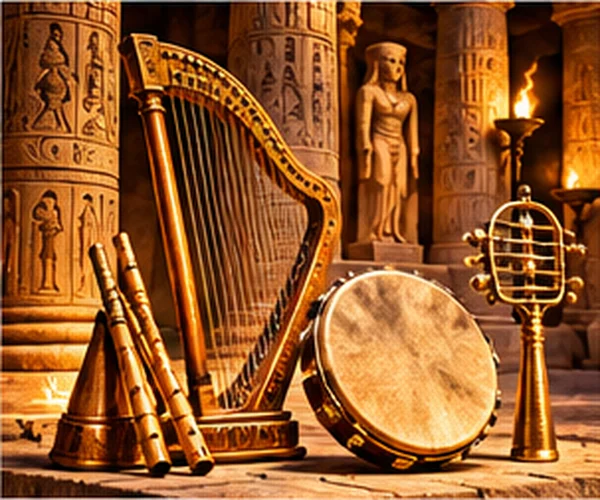
Even more striking, the ancient Egyptians knew a wide range of instruments from different families, including string, wind and percussion instruments. Paintings on the walls of tombs and temples, together with instruments found by archaeologists, have helped build a picture of a musical world more varied than many people imagine.
The harp: the sound of strings in palaces and temples
The harp was one of the most prominent string instruments in ancient Egypt. It appeared in different shapes and sizes across Egyptian history, including arched harps with a wooden sound box and a long neck to which the strings were attached.
Not all harps were alike: some early models had four or five strings, while later periods saw more developed forms that could take a larger number of strings.
The player used his fingers, or a suitable plectrum, to set the strings vibrating and produce notes, and the harp often accompanied singing at parties, celebrations and religious rituals.
Artefacts and paintings reveal the standing of harpists in society, and some funerary scenes show musicians performing in front of the tomb owners.
The lute and the lyre: variety among string instruments
The ancient Egyptians also knew lute-like instruments with a long neck and a relatively small sound box, with strings running along the neck. This let the player change notes by pressing the strings at different points.
The lyre, a framed string instrument, spread in Egypt during various historical periods and appeared in different forms, some decorated with distinctive designs.
The presence of these instruments reflects clear development in music making: strings gave musicians possibilities different from percussion and wind instruments, and allowed a variety of accompaniments.
The ney and pipes: the music of the air
Ancient Egyptian music was not limited to strings. Egyptians used wind instruments, chief among them the ney (end-blown flute), whistles, and single and double reed pipes.
These were made from materials such as reed and wood, and examples survive in museums, some dating to the New Kingdom.
One of the best-known types is the double pipe, built from two tubes that could be blown together to produce simultaneous or closely related sounds. Such instruments appear in paintings of musical ensembles and celebrations.
Notably, wind instruments remained an important part of Egyptian music over long ages, even though their forms and techniques changed over time.
Drums and frame drums: the rhythm that moved the celebrations
If strings made the melody, rhythm gave the music its movement. The ancient Egyptians used drums, frame drums, tambourines and other percussion instruments.
Some drums were made from a wooden body or a frame covered with stretched skin, sounding when the surface was struck. Round frame drums were also known, and could be carried and moved while playing.
These instruments appear in scenes of celebration and dance, where rhythm was an essential part of group performance.
The sistrum and rattles: an instrument with a sacred role
One of the instruments most closely linked to ancient Egyptian civilisation is the rattle known as the sistrum, or “sacred sistrum”.
It was usually made from a metal or wooden frame with rods or metal rings passing through it that jingled when shaken. It was not just a way to make rhythm: its use was tied to religious rituals, especially the worship of the goddess Hathor.
The Egyptians also used wooden or ivory clappers, which made a clear sound when the two pieces struck each other.
Can we hear original pharaonic music today?
Here comes one of the biggest surprises in the history of ancient Egyptian music. Although we have real instruments and paintings of musicians, we have no sound recordings of the melodies the Egyptians listened to.
Nor has a complete, reliable system of music notation reached us from pharaonic Egypt, so researchers cannot identify the original melody of each song or know exactly how it was performed.
What we know comes from studying the instruments and the materials they were made from, the positions of the musicians in paintings, and texts connected with music and celebrations.
That makes the study of ancient Egyptian music an exciting field combining archaeology, history, the arts and acoustics.
A musical heritage worth discovering
The variety of instruments the ancient Egyptians knew shows that music was a developed art with a strong presence in society. They had string, wind and percussion instruments, used them on many occasions, and left behind archaeological evidence that lets us reimagine part of their musical world.
Perhaps the most exciting thought is to imagine an ancient Egyptian ensemble with a harpist, a ney player and a group of drummers and sistrum players performing in a palace or at a religious festival.
We may not know exactly how their melodies went, but we know that music was a genuine part of their civilisation, and that the Egyptian passion for sound, rhythm and art goes back thousands of years.
Egyptian music did not begin with recording machines and modern studios; it has a deep history reaching into the depths of human civilisation.
Further reading
- The Egyptian Museum in Cairo: ancient musical instruments
- UCL Digital Egypt: musical instruments in ancient Egypt
- The Metropolitan Museum of Art: a harp from ancient Egypt
Read and listen next

More articles
- Want to be a singer? The complete step-by-step guide to learning to sing and vocal exercises
- Ammar El-Sherei: the "Diver in the Sea of Melody" who composed the music of "Raafat El-Haggan"
- Sayed Mekkawy: the sheikh who saw music with his heart and composed "El-Leila El-Kebira" and "Ya Mesaharni"
- All articles