By BOBOS · 8 November 2026 · 6 min read
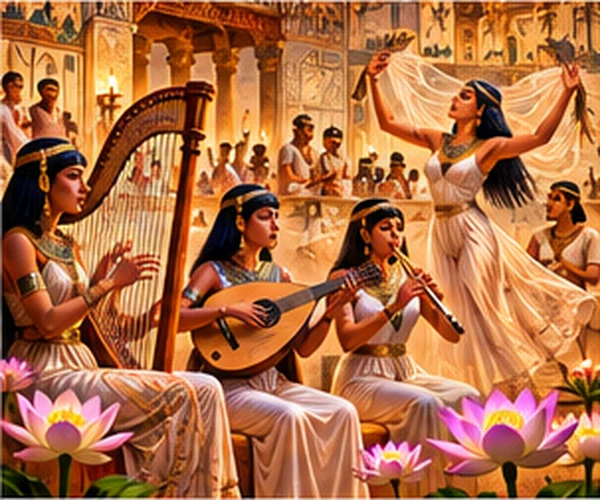
Imagine travelling back in time to Egypt more than three thousand years ago. You enter a temple and hear the sound of sistrums and pipes, then move on to the palace of a high official where musicians and female singers are giving a performance, and after that you pass a popular celebration full of drums, frame drums and dancing.
This scene is not cinematic fantasy; it is a picture that can be rebuilt from the paintings, reliefs, statues and wooden models the ancient Egyptians left behind.
Music was an important part of their lives, tied to worship, celebrations, social life and even beliefs about death and the afterlife.
What is fascinating is that music was not the property of one class: it appeared in the lives of kings and nobles, and it was tied to religious rituals and community occasions.
First: music in temples and worship
Music had an important role in ancient Egyptian religious rituals. Voices, singing and percussion instruments were used in certain rites and festivals connected with the gods.
One of the instruments most associated with these rituals was the sistrum, or sacred rattle, which made a distinctive sound when shaken.
It was linked especially with the goddess Hathor, associated in ancient Egyptian belief with joy, music, dance, love and motherhood.
Texts and monuments also mention women holding titles such as “Chantress of Amun”, which points to people with religious roles connected to singing and chanting inside the temples.
Religious singing was not entertainment; it was part of a system of rites meant to glorify the gods, perform the rituals and preserve the sacred order as the Egyptians understood it.
Second: music in palaces and at the banquets of kings and nobles
Life inside ancient Egyptian palaces was not without music. Paintings in some tombs show ensembles with harp, lute, pipe and drum players, alongside singers and dancers.
These ensembles performed at banquets, private occasions and celebrations organised by the owners of the house.
One of the best-known pieces of evidence is a wooden model of a musical ensemble found at Saqqara, dating to the Middle Kingdom. It shows a group of musicians and singers performing for their master.
Its importance is that it is not just an artistic image; it gives us an idea of how musical performances were organised and who took part.
Funerary scenes also reveal professional musicians, suggesting that music was a field of work and specialisation, not just a hobby for leisure time.
Third: music and dance at popular celebrations
Singing, dancing and rhythm were important elements of ancient Egyptian celebrations.
Reliefs show groups of women and men dancing to drums, frame drums and pipes, and some scenes show clapping used to keep the rhythm and accompany the dancers.
Music was a way to express joy and share in the community, whether at seasonal celebrations, feasts or social occasions.
It is important not to imagine that all celebrations were the same: the kind of music, the number of participants and the instruments differed with the occasion, the place and the social class.
But the presence of music and dance in so many archaeological scenes confirms that they were strongly present in ancient Egyptian life.
Fourth: music in the processions of the gods and great religious festivals
Religious processions were important occasions in ancient Egypt, some of them involving statues of the gods being carried from the temples to other places during festivals.
On these occasions music was not just background sound; it was part of the festive scene itself.
Drums, wind instruments, sistrums and singing were used in some processions and rituals, adding a clearly communal character to the celebration.
One of the best-known ancient Egyptian festivals is the Opet Festival in Thebes, tied to a religious procession between the temples of Karnak and Luxor, and one of the major events of the religious calendar.
Reliefs and artistic depictions connected with these festivals help us understand the relationship between music, ritual and collective movement in Egyptian society.
Fifth: music in funerals and the afterlife
It may seem strange that music was present in scenes of death and burial, but the ancient Egyptians did not see death as the end of existence.
Their funerary beliefs were tied to the idea of another life, and preparing the tomb and its contents was part of getting ready for the journey to the afterlife.
That is why scenes of musicians and singers appear in some tombs, and musical instruments and models of ensembles have been found in funerary settings.
Placing some of these models and objects in tombs was meant to let their symbolic benefit continue for the deceased in the next life, according to the beliefs of the time.
Among the best-known scenes are harpists performing, and there are texts known as the Songs of the Harper, literary texts linked to scenes of musicians in tombs, some of which reflect on life, death and human destiny.
These texts are fascinating because they show that music was not always tied to joy alone; it was also a way to express deep philosophical and human ideas.
Sixth: music in the army and official processions
Sound and rhythm also had a role in some military and official activities.
Ancient Egypt knew trumpets and drums, and metal wind instruments appear in contexts connected with the army and official occasions.
Among the best-known finds are the trumpets discovered in the tomb of King Tutankhamun, rare pieces that give us physical evidence of these instruments.
We should not assume that every use of trumpets was musical in the modern entertainment sense: some sounds served purposes of announcing, signalling and organising movement, alongside the instruments’ presence at celebrations.
Seventh: did they have love songs and songs about feelings?
Yes. Ancient Egyptian texts reveal a body of lyrical and poetic literature dealing with love, emotion and human relationships.
Among the most notable examples are the love songs that have reached us from the New Kingdom, full of expressions of longing, admiration, meeting and waiting.
There are also texts connected with harpists, some dealing with ideas about life, enjoying one’s time and thinking about death.
But it is essential to distinguish between the texts that have survived and the melodies that went with them: we have literary and archaeological evidence, but no complete record of the original musical performance.
Did ancient Egyptian music sound like the music we know today?
We cannot give an exact answer about the shape of the melodies, modes or rhythms as they were actually played, because the available musical evidence does not allow every detail to be rebuilt.
But we can say with confidence that the ancient Egyptians had a varied musical culture, and that music served religious, social, festive and funerary purposes.
Most importantly, music was tied to every stage of human life, from celebration and joy to worship, reflection and the rites of death.
Music thousands of years old that still makes us curious
When we look at the paintings on tomb and temple walls, and at the instruments that have survived thousands of years, we realise that music was no minor matter in ancient Egyptian civilisation.
It was a means of expression, communication, celebration and worship, present in palaces, temples, processions and tombs.
Perhaps the most astonishing thing is that we know so much about the instruments, the musicians and the occasions for music, yet we cannot listen to an original pharaonic song as it was performed in its time.
The sounds have gone, but the images, instruments and texts have kept part of the story for us.
The ancient Egyptians did not only build pyramids and temples; they also left a musical heritage worth discovering, studying and presenting again to new generations.
Further reading
- UCL: music in ancient Egypt
- The Egyptian Museum in Cairo: ancient musical instruments
- Berlin museums: the exhibition on music in ancient Egypt
- The Egyptian Museum in Turin: the flute in ancient Egypt
Read and listen next
- Music in ancient Egypt: instruments ahead of their time
- From the pharaonic harp to electronic music
- Songs written for a wedding

More articles
- Want to be a singer? The complete step-by-step guide to learning to sing and vocal exercises
- Ammar El-Sherei: the "Diver in the Sea of Melody" who composed the music of "Raafat El-Haggan"
- Sayed Mekkawy: the sheikh who saw music with his heart and composed "El-Leila El-Kebira" and "Ya Mesaharni"
- All articles