By BOBOS · 8 November 2026 · 6 min read
Is Arabic music just an Eastern copy of Western music? Was the Egyptian song more authentic in the past than what we hear today? And who first brought Western instruments and styles into Arabic music?
These questions open one of the most important debates in music history. The relationship between Arabic and Western music is not a story of imitation from one side, but a long history of mutual influence, renewal and artistic experiments that changed the shape of music in the world.
To understand the truth, we need to go back long before the modern song appeared.
First: is Arabic music older than Western music?
We cannot treat Arabic and Western music as if one began on a particular day before the other. Both have deep historical roots, and European music itself went through different stages, from early and church music to classical, romantic and modern music.
But Arabic music has had its own traditions for centuries, including maqams, melodies, muwashshahat, qasidas, adwar and tawasheeh.
Among the main features of Arabic music are the maqams that give a melody its character, attention to vocal ornamentation and improvisation, and the use of quarter tones in a number of maqams.
European classical music developed in other directions, focusing on notation, harmony, polyphony and orchestral composition.
That does not mean one system is better than the other; each has its own philosophy, tools and history.
Second: when did Western influence on Egyptian music begin?
The nineteenth century can be seen as an important turning point in Egypt’s relationship with European music.
With the French campaign in Egypt in 1798, and then growing cultural contact with Europe during the nineteenth century, new influences began to appear in Egyptian artistic life.
The era of Khedive Ismail gave this influence a big push, especially with the opening of the Khedivial Opera House in Cairo in 1869.
Cairo began hosting opera and European music performances, and Egyptian musicians became more familiar with Western instruments, large ensembles and different styles of composition and arrangement.
This was the start of a new stage of interaction between Eastern and Western music.
Third: who first brought Western music into the Egyptian song?
There is no precise answer naming one person as the very first, because Western influence entered Egypt gradually through bands, theatre performances and foreign instruments.
But one of the most important pioneers of renewal was Sheikh Salama Hegazi, who developed musical theatre and presented Arabic work in theatrical forms influenced by the European experience.
Then came Sheikh Sayed Darwish, who brought about a major shift in Egyptian music in the early twentieth century.
Sayed Darwish was different because he did not just use new musical styles; he steered the song towards everyday Egyptian life.
He wrote songs about workers, craftsmen, sailors and porters, and cared about expressing social characters and national themes.
He also drew on modern arrangement and composition, and his work shows experiments with the Western orchestra alongside the Egyptian musical spirit.
So he was not just someone who brought in foreign music, but one of the most important artists who helped found a new form of the Egyptian song.
Fourth: Mohamed El Qasabgi and Mohamed Abdel Wahab, a new stage of blending
After Sayed Darwish came a generation of musicians who widened the space for renewal.
Mohamed El Qasabgi was one of the most important names in developing composition and arrangement, bringing new instruments and styles into the Arabic song while keeping its Eastern foundation.
Mohamed Abdel Wahab was one of the musicians most interested in Western music, drawing on the orchestra, modern instruments, harmony and Western rhythms.
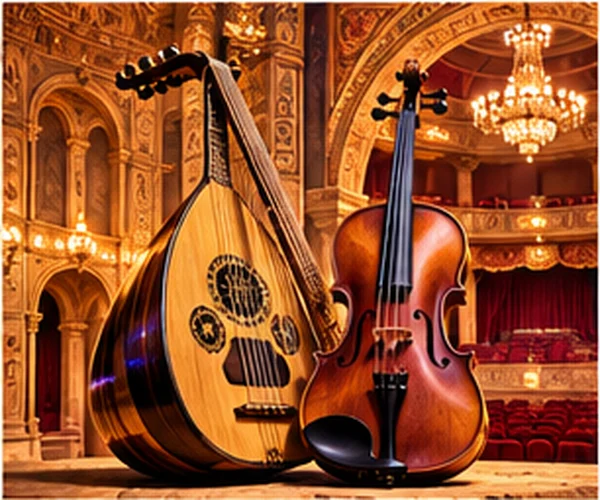
You can hear this in many of his works, where he combined the oud, violin and ney with the piano, guitar and other Western instruments.
The song “Enta Omri”, which he composed for Umm Kulthum in 1964, was one of the landmark moments that showed how far modern Arabic arrangement had developed.
This was not simply copying the West, but an attempt to present the Arabic song in a musically broader form.
Fifth: did the West also take from Arabic music?
The historical relationship between Arabic and European music is more complicated than the idea that the West was the only source of progress.
There was long cultural interaction through Andalusia, the Mediterranean, trade, migration and contact between civilisations.
Some instruments and musical concepts moved between cultures, and Arab and Islamic musical traditions influenced various European settings.
But we should be careful about claiming that all modern Western music comes from Arabic music; there are mutual influences whose direction or size is sometimes hard to pin down precisely.
Music belongs to no single culture, and history shows that peoples constantly exchange ideas, instruments and artistic styles.
Sixth: what happened when electronic music reached the Arab world?
With modern recording, radio and cinema, the Arabic song began to change more.
Then electric and electronic instruments arrived, and it became possible to record in a studio and add different musical layers.
As disco, pop, rock, hip hop and electronic music spread, Arab producers began experimenting with new musical colours.
In Egypt specifically, forms combining the shaabi song with electronic beats appeared, followed by the spread of mahraganat, rap and trap.
Here Western influence was no longer limited to instruments; it reached the way the song itself is made, from building the beat to delivery, recording and arrangement.
Even so, Egyptian artists managed to keep clear local elements, such as the Egyptian dialect, shaabi rhythms and Eastern ornamentation.
Seventh: when is influence creativity, and when does it become copying?
There is a big difference between learning from a global musical experience and copying it as it is.
When a producer uses a Western beat but builds an Eastern melody on it, adds Egyptian instruments and uses a local style of delivery, he is offering an experience that brings two cultures together.
But when someone copies a melody, an arrangement or a whole work without adding a real artistic personality, we come close to imitation or undeclared borrowing.
Music history is full of artists who used elements from other cultures to create new styles that later became part of their own artistic identity.
Eighth: has modern Egyptian music lost its identity?
Not necessarily.
Egyptian music today includes many colours, from tarab to shaabi, mahraganat, rap, trap and electronic music.
Some work relies heavily on Western moulds, other work keeps an Eastern character, and some experiments try to combine the two.
A song’s identity cannot be judged by its instruments alone. A song may use piano, guitar and electronic drums yet remain Egyptian in its melody, delivery, dialect and spirit.
Equally, a song may use plenty of Eastern instruments without offering anything new or different.
Musical identity runs deeper than a list of instruments.
Conclusion: music knows no borders
Arabic music did not copy Western music, but it benefited from it at important stages of its history, just as European and world music were influenced by musical traditions from other cultures.
Egypt was one of the most important arenas of this interaction, especially from the nineteenth century, when European instruments, orchestras and styles gradually entered musical life.
From Salama Hegazi to Sayed Darwish, from Mohamed El Qasabgi to Mohamed Abdel Wahab, and on to the generations who brought rap, trap and electronic music, renewal has always been a core part of the history of Egyptian music.
The problem is not that Arabic music is influenced by the West, but that it might lose its personality when it is.
A real artist is not afraid of listening to the music of the world; he knows how to take what suits him and present it again with his own voice and identity.
Read and listen next
- Why Egyptian music should not sound like any other music
- From the pharaonic harp to electronic music
- All BOBOS songs

More articles
- Want to be a singer? The complete step-by-step guide to learning to sing and vocal exercises
- Ammar El-Sherei: the "Diver in the Sea of Melody" who composed the music of "Raafat El-Haggan"
- Sayed Mekkawy: the sheikh who saw music with his heart and composed "El-Leila El-Kebira" and "Ya Mesaharni"
- All articles